Accessibility · Communication · Languages

Accessibility services and inclusive communication

Help more people reach your events, videos, documents and training content.

At Overseas Translations we help you reduce the barriers to accessing information. We combine specialised professionals and technology to adapt your communication to your audience, your languages and your channels.

Request a proposal

What we offer. Overseas Translations is a translation agency in Barcelona with more than 13 years of experience. We coordinate five accessibility services: sign language interpreting, real-time transcription and subtitling, accessible subtitling, document adaptation and accessible e-learning. All of them can be combined with translation into other languages and include human review. We have worked with ISO 9001:2015 and ISO 17100:2015 certification since 2017.

Your audience, the starting point

Accessible communication starts with knowing your audience

Each person accesses information in a different way. Some need to follow a talk in writing, while others use sign language, on-screen instructions or keyboard navigation.

Together we identify who you are addressing and how your content will be used. From there, we coordinate the linguistic and technical profiles your project needs.

More ways to access. More opportunities to take part.

We choose the right combination of services for your event, training course or publication.

Solutions for your organisation

Our accessibility services

From live events to the materials you share afterwards, we prepare more inclusive communication.

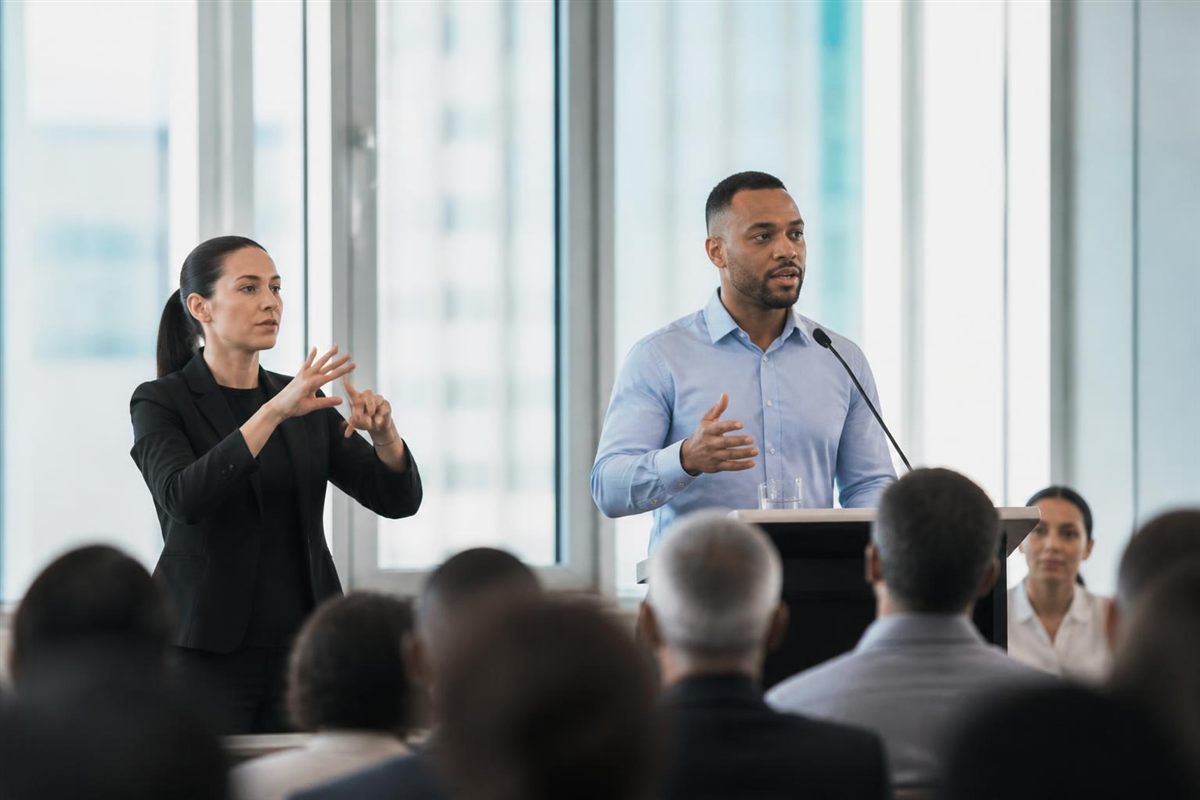
Sign language interpreter next to a speaker at a conference

Sign language interpreting

Makes it easier for deaf signers to take part in meetings, conferences, training sessions and audiovisual content.

We coordinate interpreters specialised in Spanish Sign Language (LSE) and Catalan Sign Language (LSC). We also have International Sign (IS) interpreters, depending on the audience and the subject of each project.

  • In-person and remote interpreting.
  • Conferences, seminars and press conferences.
  • Corporate training and educational activities.
  • Recording of content in sign language.
  • Interpreting for videos and broadcasts.

We define the sign language, the language combination and the visibility conditions of the service.

Discover our sign language service →
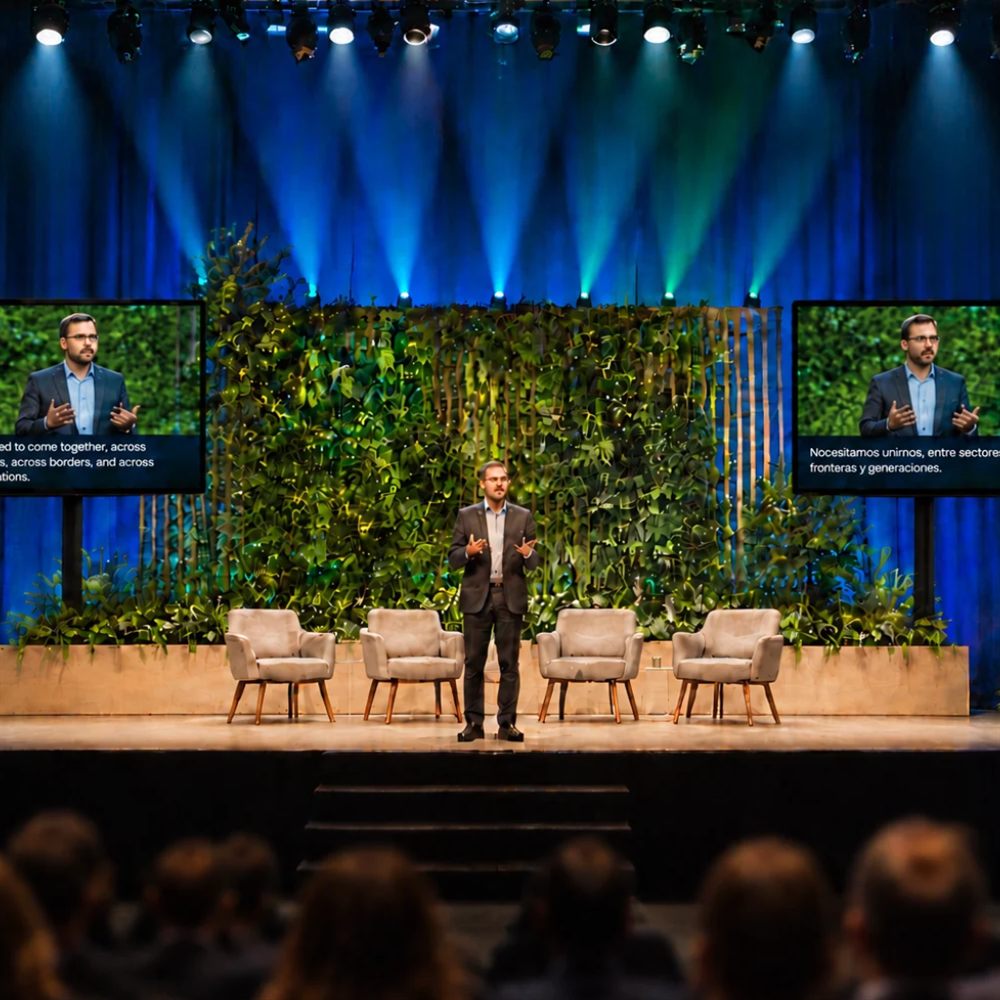
Conference on environmental sustainability with screens on both sides showing the speaker and live subtitles

Real-time transcription and subtitling

Lets your audience follow in writing what is being said during a session.

We organise live automatic transcription solutions, with access to the text from the browser, and we prepare the session so that the result is as reliable as possible.

  • Congresses and conferences.
  • Press conferences and institutional events.
  • Classes and internal training.
  • Meetings and professional gatherings.
  • In-person, virtual and hybrid events.

We check the languages, the audio, the connection and the way of accessing the text. Accuracy depends on sound quality, accents, terminology and speaker turns.

Discover our live transcription →
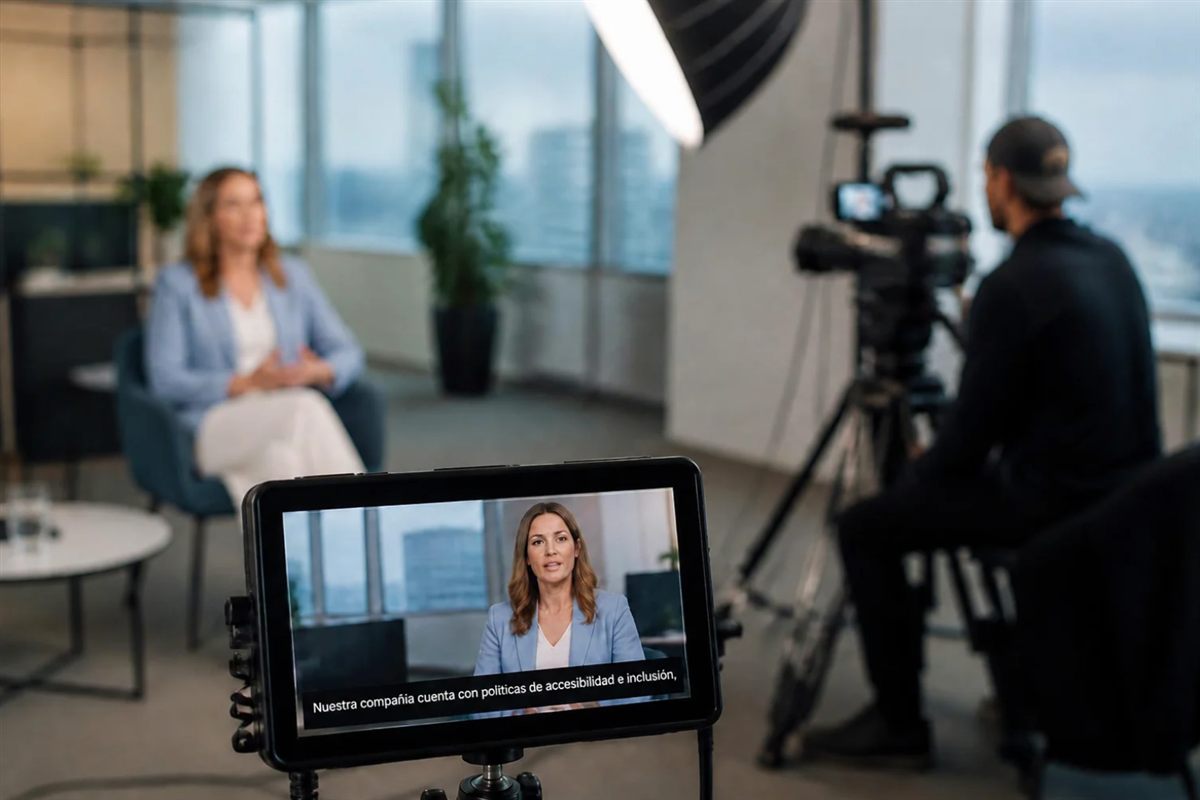
Filming of a corporate video with an interview and a video monitor showing a subtitle bar

Accessible subtitling and audiovisual adaptation

Make the audio information in your videos available as text too.

We prepare subtitles for deaf and hard-of-hearing people, including dialogue and relevant sound information: speaker identification, meaningful sounds or music, where appropriate.

  • Transcription, synchronisation and review.
  • Subtitle translation and adaptation.
  • Delivery in SRT, VTT or embedded in the video.
  • Combination with sign language content.
  • Adaptation of corporate videos, interviews and training.
Discover our subtitling service →
Two colleagues reviewing a printed document and its on-screen version

Document adaptation and structuring

Prepare your documents so that the information is easier to find, navigate and understand.

We coordinate the adaptation of Word, PowerPoint and PDF files, as well as the preparation of layout source files for later conversion.

  • Heading hierarchy and content structure.
  • Preparation of the reading order and PDF tagging.
  • Alternative text for informative images.
  • Structure of tables, lists and links.
  • Language identification and multilingual versions.

We review the source material and define the adaptations included in each project.

Discover our multilingual layout service →
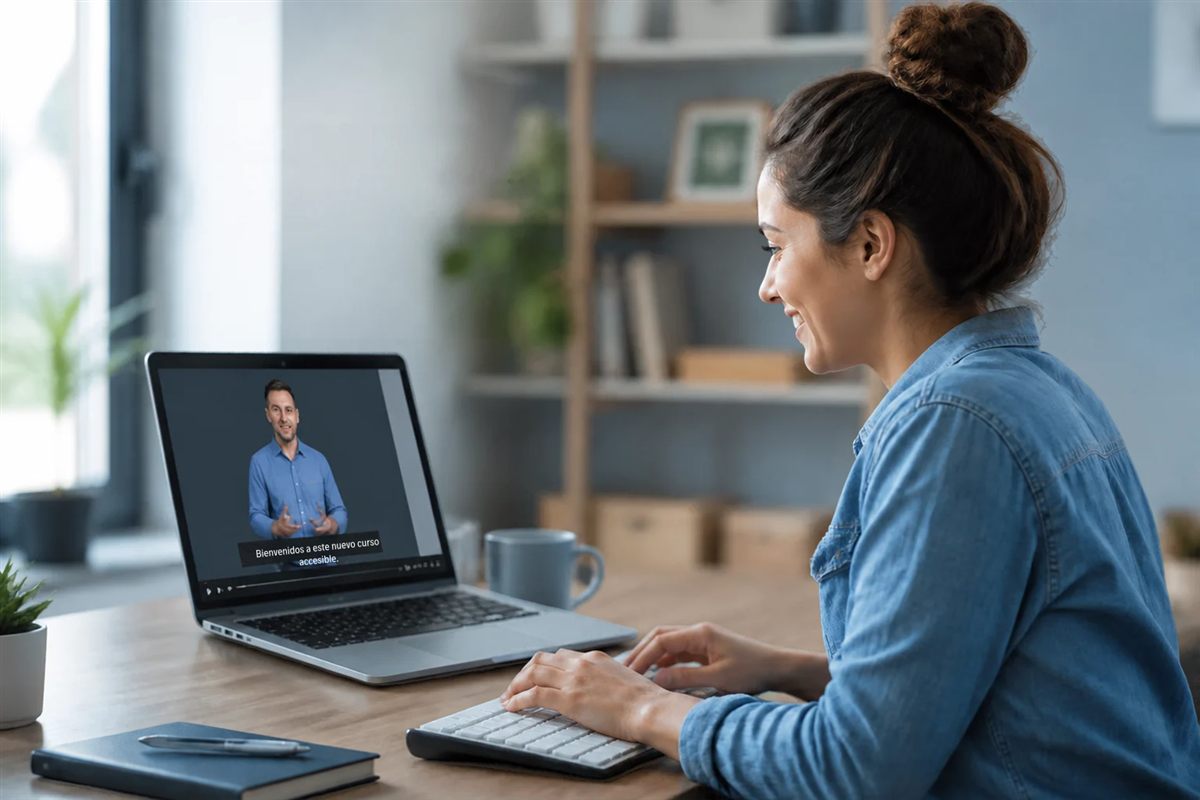
Woman following an online course with video on her laptop

Accessible e-learning and training

Widen access to your courses and learning materials. We coordinate the development and adaptation of training content with specialists in tools such as Articulate 360, Lectora and Captivate.

  • Keyboard navigation and focus order.
  • Structure and labels for screen readers.
  • Contrast and legibility.
  • Text alternatives to visual elements.
  • Subtitles and transcripts for audiovisual resources.
  • Adaptation of activities and assessments.
  • Course translation and localisation.
  • Preparation for the agreed publishing environment.

The scope is defined according to the content, the possibilities of the tool and the platform where it will be used.

Discover our e-learning translation →

Not sure which one you need?

Tell us which event, video, document or course you want to adapt and we will suggest the simplest combination.

Get in touch
Upper deck of a Virgin Voyages cruise ship at sunset
Case study

Virgin Voyages: sign language on board

A last-minute request: sign language interpreting during an eight-day cruise in the Caribbean.

  • Spoken English and sign language (LSE and LSF), in both directions.
  • Four interpreters, two for LSE and two for LSF, from Spain and France.
  • Information sessions, shows and excursions throughout the eight days.
Read the full case →
To choose with confidence

Which service fits your needs?

Accessibility services according to audience needs
If your audience…You needWhat you get
Is a deaf signer attending an event or meetingSign language interpretingLSE, LSC or IS interpreters, in person or remote
Wants to follow a live session in writingReal-time transcription and subtitlingText accessible from the browser and a transcript afterwards
Will watch a recorded video without being able to hear the soundAccessible subtitlingSRT or VTT subtitles, with speakers and relevant sounds
Reads manuals, reports or presentationsDocument adaptationWord, PowerPoint or PDF with structure, reading order and alternative text
Learns online with your courseAccessible e-learningCourse adapted for keyboard, screen readers and subtitles, and translated if needed
From voice to text (Speech to Text)

How does live transcription work?

This is how we organise a session with live text, from preparation to delivery.

  1. We prepare the session

    We define the languages, the vocabulary and audience access. We check the audio and the connection.

  2. We turn voice into text

    The system processes the audio and generates a transcript during the speeches.

  3. Your audience follows the session

    Participants read the text from the browser on the agreed device.

  4. We prepare the follow-up content

    If you need it, we handle the download, review and translation of the text or the subtitles for the recording.

An example of use

A press conference with more ways to access it

If you organise an in-person press conference with an online broadcast, we can combine resources so that more people can follow the same message.

  • Interpreting into the appropriate sign language.
  • Live transcription accessible from the browser.
  • Multilingual options for international attendees.
  • Reviewed subtitles for the recording.
  • Follow-up transcript ready to publish.

We plan the coordination between speakers, interpreters and the audiovisual team, including speaker turns.

This is how your audience sees it Live

Journalist: “How long did it take you to write the novel?”

Writer: “Almost three years, although the idea had been with me for a long time.”

Writer: “I started writing it during a train journey…”

(Illustrative example: this is how the text appears in the browser or on the mobile phone of an attendee while the person speaks. Each contribution carries the name of the speaker and the last line is completed in real time.)
The Overseas difference

Accessibility and multilingual communication in a single project

If your organisation works in several languages, you need to keep things clear in every version. We coordinate translation, localisation and accessibility with a single point of contact, so that you do not have to manage several suppliers.

We help you keep terminology consistent and review texts, subtitles and materials in the different languages. We have more than 13 years of experience, ISO 9001:2015 and ISO 17100:2015 certification since 2017 and human review in every delivery.

How we work with you

  1. We analyse your needs: content, audience, languages and channels.
  2. We define the scope: services, formats and adaptations included.
  3. We coordinate the project: linguistic, audiovisual and technical professionals.
  4. We deliver the materials: with the instructions needed to use them.
We answer your questions

Frequently asked questions

Does live transcription replace sign language?

No. They are resources that meet different needs. A deaf signer follows sign language interpreting better, while someone who reads comfortably may prefer live text. The choice depends on how your audience accesses information, and at many events both are combined.

What is the difference between live transcription and subtitling?

Live transcription shows in writing what is being said as it is said, so you can follow a session in the moment. Accessible subtitling is prepared on an already recorded video, is synchronised with the image and includes, where appropriate, speaker identification and relevant sounds.

How does the audience access live transcription?

Participants read the text from their browser, on the device we agree for the event. Before the session we check languages, audio, connection and the way of accessing the text.

How accurate is live transcription?

It depends on sound quality, accents, terminology and speaker turns. That is why we prepare the session in advance and, for the later recording, we carry out a human review of the text.

Can you adapt materials we already have?

Yes. We review your videos, documents, presentations or courses to determine which adaptations they need and which can be included in the project.

Can you prepare content in several languages?

Yes. We combine translation and localisation with subtitling, transcription and document adaptation, and we keep terminology consistent in every version.

Which subtitle formats do you deliver?

We deliver subtitles in SRT and VTT, or embed them in the video itself. If your platform requires another format, let us know when you request a quote.

What does the adaptation of documents and courses include?

It depends on the format, the content and the environment where they will be used. We analyse the source material and specify in each project which adaptations are included.

What do you need to prepare a quote?

Send us the material or describe the event. Tell us the target audience, the languages, the format and the date. With that we prepare a tailored proposal.

Hands of a sign language interpreter during a conference
Let's talk about your project

Help your communication reach more people

Tell us what you need, from a meeting with live text to a multilingual course.

Request a quote

Any questions? Write to us

Tell us what you need and we will reply as soon as possible.

adorno billete
Subscribe to our newsletter