A sworn translation is an official linguistic certification with full legal validity before public authorities, courts and official institutions. Unlike a standard translation, it must be produced, signed and stamped by a sworn translator or interpreter appointed in Spain by the Ministry of Foreign Affairs, European Union and Cooperation (MAEC), who attests to the faithfulness and accuracy of the content with respect to the original text.
In cross-border trade, immigration procedures, international litigation and corporate transactions, using an accredited sworn translation service is essential to guarantee the legal certainty of the procedure and avoid administrative rejections caused by unauthorised translations.
What exactly is a sworn translation and how valid is it?
In documentary terms, a sworn translation has a legal status comparable to that of a notarial deed. The sworn translator doesn’t act merely as a linguistic intermediary but as a public attester of the accuracy of the translated document and its correspondence with the original. For this reason, the translator bears direct personal civil and criminal liability for the faithfulness of the text.
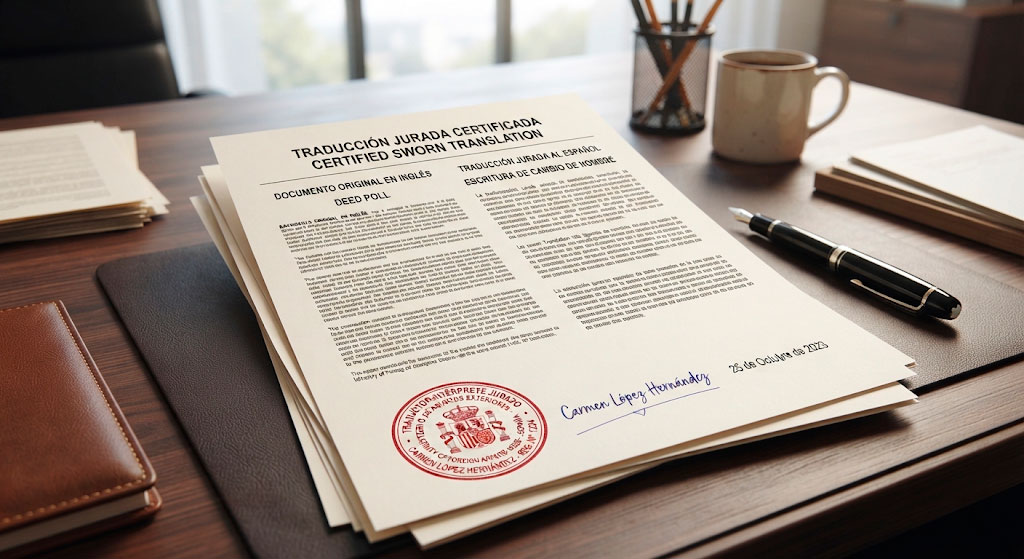
For a sworn translation to be legally valid in Spain or before foreign consulates, it must include the following formal elements, set out in MAEC regulations:
- The translator’s official stamp: showing their full name, the language or languages they are authorised for and their official registration number.
- Certification statement: a legal text at the end of the document certifying that the translation is a faithful and complete rendering of the original document.
- The sworn translator’s signature: which can be handwritten on paper or applied using a recognised electronic signature certificate for online submissions and electronic files.
- An attached copy of the original document: dated and stamped on every page to formally link it to the translated text.
The difference between sworn translation and legal translation
Although the two concepts are often confused, they refer to different operational and methodological realities. Sworn translation refers to the format and the legal validity conferred by the sworn translator’s status, whereas legal translation refers to the area of law the text covers (contracts, legal opinions, legislation or articles of association), which doesn’t always require sworn certification if it’s used purely for information or internal work.
| Criterion | Sworn translation | Legal translation |
|---|---|---|
| Official validity before authorities | Full, with public attestation | Informative and contractual (no public attestation per se) |
| Qualification required | Official appointment issued by the MAEC | Professional translator specialising in law |
| Delivery format | Stamped and signed paper or PDF with official digital signature | Editable digital document or PDF with no stamping requirements |
| Document type | Any document that has to be submitted to a public body | Purely legal, regulatory and procedural texts |
| Translator’s liability | Civil and criminal liability as a public attester | Standard contractual and professional liability |
“A legal translation requires a thorough command of procedural and comparative law; however, it only acquires evidential force before a judge or the public authorities when it takes the form of a sworn translation.”
When a sworn translation is required: individual and corporate cases
Any document issued in a foreign language must be accompanied by a sworn translation if it is to have effect in an administrative or judicial procedure in Spain, unless it is expressly exempt under a bilateral treaty or EU legislation. Cross-border business and commercial procedures also frequently call for this type of service.
Corporate and business
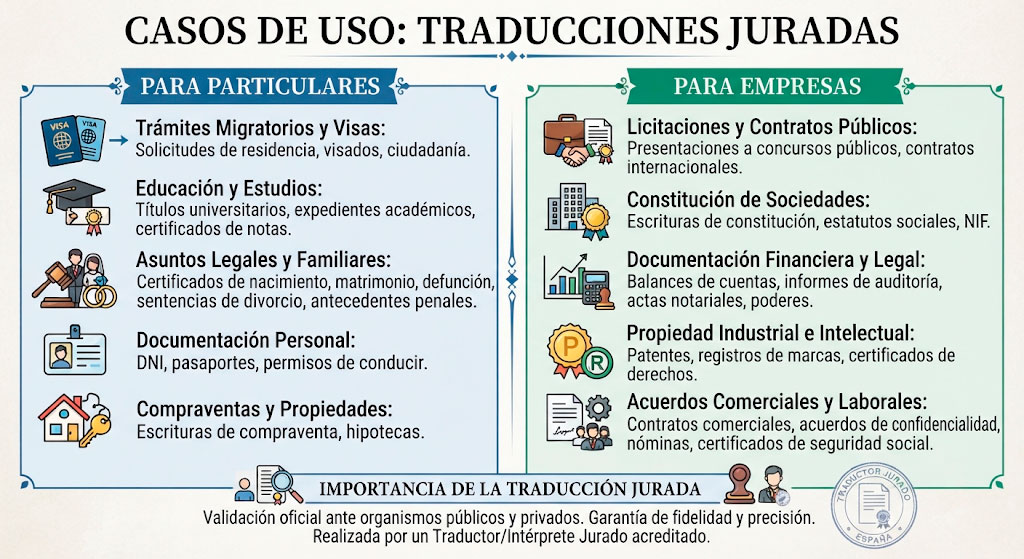
Organisations involved in international tenders, company acquisitions or opening subsidiaries need sworn translations of their core corporate documentation:
- Deeds of incorporation, mergers and articles of association.
- Notarial powers of attorney, commercial representation and appointments of directors.
- Annual accounts, balance sheets and external audit reports.
- Patents, commercial framework agreements and non-disclosure agreements.
- International public tenders and approved technical documentation.
Judicial and court proceedings
In international judicial cooperation, hearings and arbitration, courts and tribunals reject any documentary evidence that hasn’t been formally sworn. In the same setting, when parties appear who don’t speak the language of the proceedings, sworn interpreting is provided in the courtroom to guarantee effective judicial protection.
Civil matters and individuals
For immigration procedures, recognition of qualifications or changes in civil status, official bodies require sworn translations of:
- Birth, marriage and death certificates, and certificates of life.
- University degrees, transcripts and academic records.
- Criminal record certificates and official medical certificates.
- Employment contracts and proof of financial or bank solvency.
Delivery formats: paper or digital signature
Traditionally, sworn translations were delivered on paper with the translator’s ink stamp and handwritten signature on every page. However, with the digitalisation of public administration and in line with the provisions of the Ministry of Foreign Affairs, European Union and Cooperation, an advanced electronic signature based on official certificates has exactly the same legal validity.
The digital option speeds up online processing times and removes logistics costs. If the receiving body requires physical delivery or in-person validation, paper delivery remains fully valid.
Tips for ordering a sworn translation without a hitch
To speed things up and make sure your file isn’t rejected at the counter because of formal defects, it’s worth planning your order with these steps:
- Check for prior legalisation or an apostille: if the original document comes from a country that is a signatory to the Hague Convention, it must bear the Hague Apostille before it is translated, as the sworn translator will also translate the apostille stamps.
- Scan the document so it is fully legible: the sworn translator must transcribe or describe embossed seals, ink stamps, handwritten notes and the backs of pages. A complete high-resolution scan avoids illegibility notes in the certification.
- Allow enough time: sworn translation does not allow for unsupervised automated processes or post-editing without human certification, and it requires the time needed for rigorous terminology analysis and legal verification.
Request a no-obligation quote
Frequently asked questions about sworn translation
No, the sworn translation itself has no expiry date. However, its validity is intrinsically linked to the validity of the original document it translates: if a criminal record certificate expires after three months, the sworn translation loses its practical use once that period has passed.
It isn’t compulsory. The sworn translator can work from a high-quality scanned PDF copy, on which they will stamp their seal and date of receipt, certifying that the translated text corresponds to that attached digital copy.
No. Sworn translation requires the professional appointed by the MAEC to take on direct legal responsibility. Although the translator may use corporate translation memories to standardise glossaries, the work of translating, reviewing and checking is strictly personal and cannot be delegated to automated systems.
The sworn translator will expressly record clarifying notes in square brackets, such as [illegible] or [illegible signature], giving an exact account of the physical condition of the document without interpreting or inventing missing information.
As a general rule, countries that have signed legal cooperation treaties or are members of the European Union accept translations by official Spanish sworn translators. For other non-EU countries, additional legalisation of the translator’s signature before the MAEC or the relevant consulate may be required.